






Blockchain Infrastructure/RPC Providers Compared in 2026

July 10, 2026
6 min read
Anyone evaluating an RPC provider eventually runs into the same set of comparison articles, most of which rank Alchemy, QuickNode, Infura, Chainstack, Tatum, and Ankr against each other primarily on price per million requests. That comparison leaves out most of what actually determines whether a provider works well in production: how much traffic the plan can absorb before requests start failing, how tightly a key can be scoped if it leaks, how quickly a team finds out something has gone wrong, and, increasingly, whether the data coming back can be trusted without having to run your own node to check it.
The following is based on each provider's own pricing and documentation pages as of June 2026.
A brief overview of the field
- Alchemy has strong developer tooling and a large existing user base, though self-serve throughput tops out in the range of 300 requests per second, and crypto payments are confined to Enterprise plans.
- QuickNode is well documented and generally reliable. Reaching 500 requests per second requires the $999/month plan, and there's no way to restrict a key to specific smart contracts.
- Infura is a common default, particularly for teams already in the MetaMask ecosystem, but it doesn't offer IP allowlisting, and there's no account-management API for handling billing or team access programmatically. Heavy methods such as debug_traceTransaction can run well over $100 per million calls.
- Chainstack offers four team role tiers, which is more granular than most competitors, but archive data sits behind a paywall, and there's no contract-level key restriction.
- Tatum is easy to get started with and API-first in its design, but per-key security controls are minimal, there's no crypto payment option, and trace and debug calls are priced roughly 25 times a standard call.
- Ankr's published figures show the highest self-serve throughput among this group, pricing that doesn't multiply by method type, archive access included on every tier including free, and a verifiable RPC product that, as far as we can tell, no other major provider currently offers.
That's the short version. The rest of this piece goes into more detail on where Ankr's numbers come from and why they matter in practice.
The Complete Comparison
In our efforts to be truly developer-first, Ankr provides some of the most generous free and premium terms available.
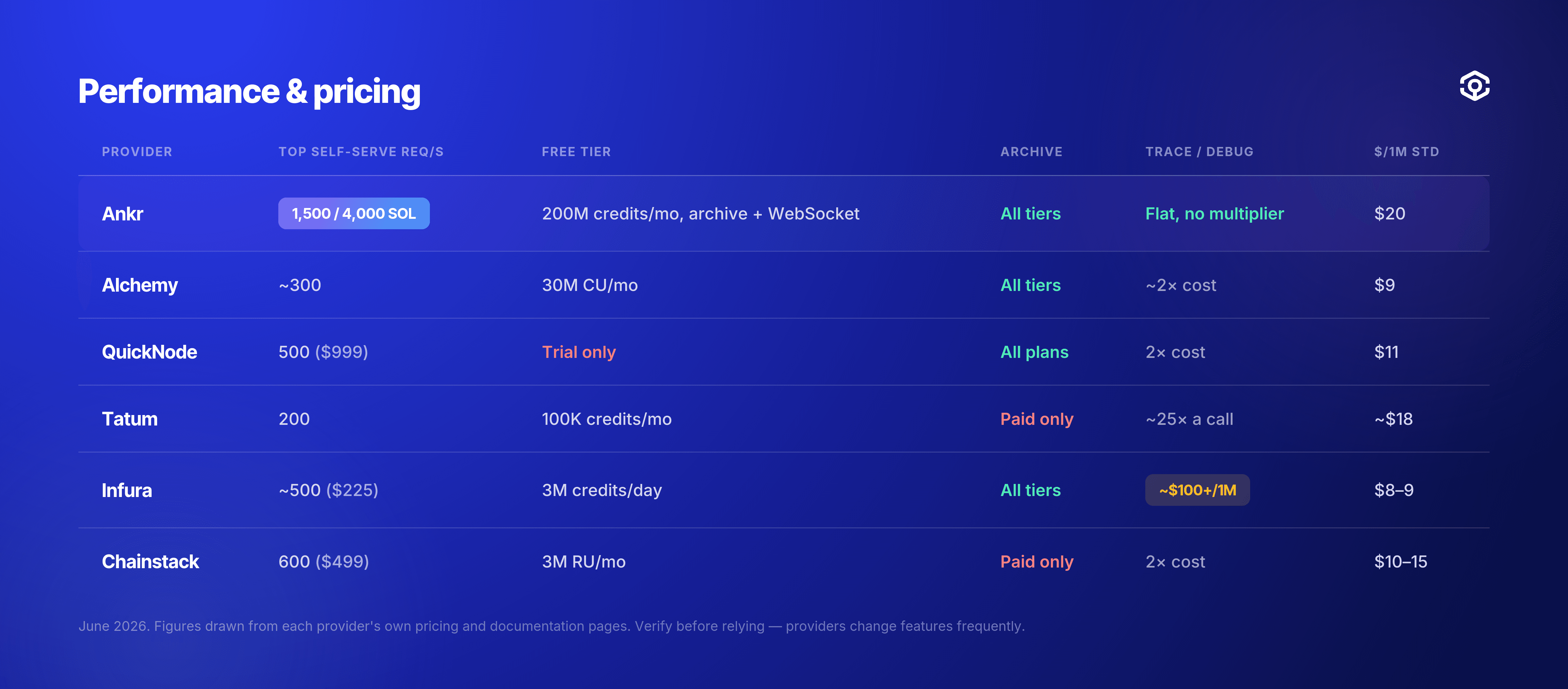
Ankr has spent years building and refining our platform to the desires of our users. We’re proud to offer a feature-rich experience to every user tier.
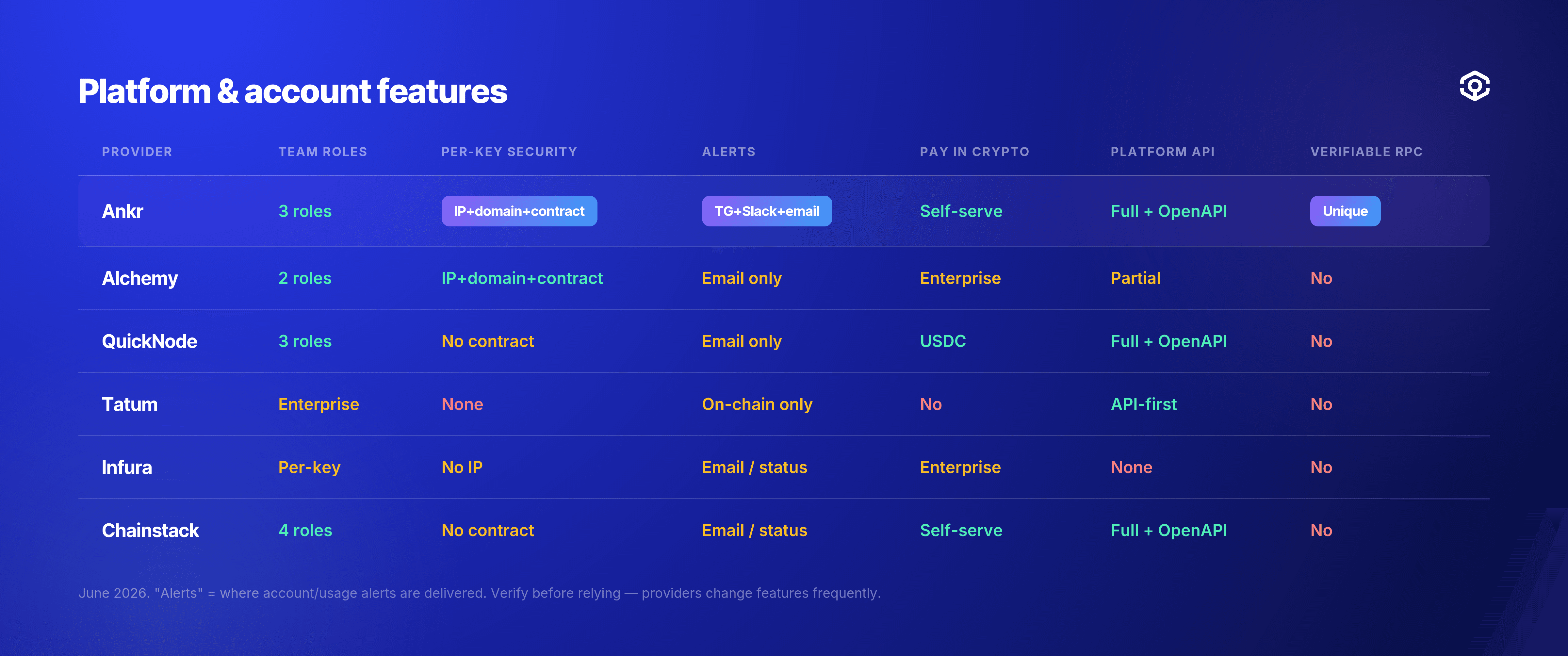
What you won't get from Alchemy, QuickNode, or Tatum
✅ Verifiable RPC. Signed, attested responses you can verify yourself. Based on our research, no other major provider currently offers this. More on vRPC →
✅ Telegram and Slack alerts. Balance and blockchain-status alerts pushed to chat. Other providers send usage alerts to email only, and none of them support Telegram.
✅ Smart-contract key locks. Restrict a key to specific contracts, not just IP and domain. QuickNode, Chainstack, and Tatum can't do this.
✅ Flat heavy-method pricing. Trace and debug cost the same as a basic call. Others charge two to twenty-five times more; Infura's debug pricing tops $100 per million.
✅ Archive on every tier. Full history, including on the free plan. Chainstack and Tatum paywall archive.
✅ Highest self-serve throughput. 1,500 requests per second (4,000 on Solana), pay-as-you-go. Others gate comparable throughput behind $225–$999/month plans.
Superior Throughput From Ankr
Requests per second is the ceiling that determines whether an application starts returning errors under real traffic, and it's also the number most providers keep behind a paywall or a sales conversation.
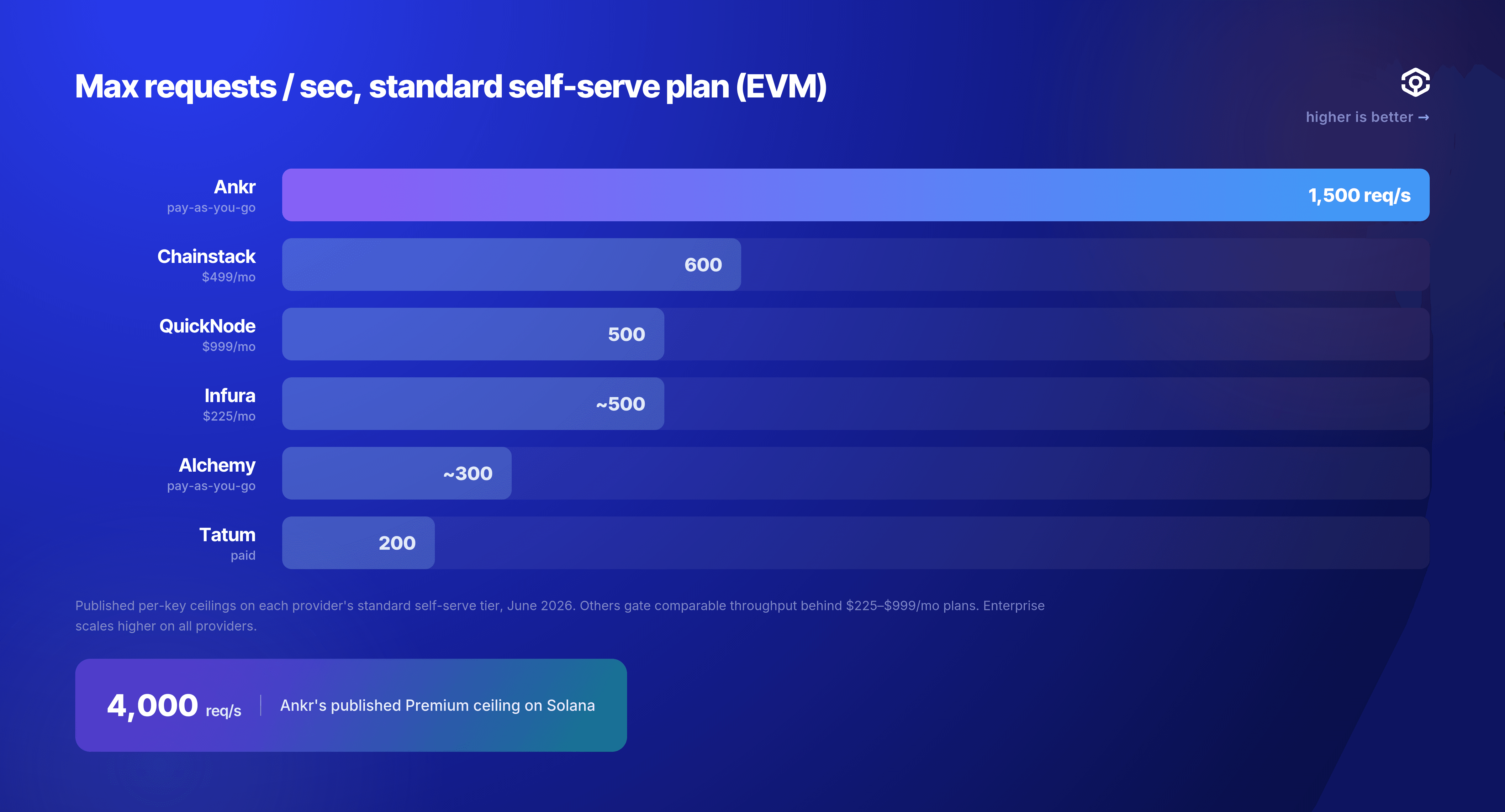
Ankr's published Premium ceiling is 1,500 req/s and 4,000 on Solana. Across the group, the pattern is that meaningful throughput is usually gated behind a high tier; Ankr's is available at the entry point.
Flat credits, no method multipliers
Most providers price by method rather than by request. A trace or debug call typically costs two to twenty-five times what a basic call costs, and archive queries can add another layer of cost on top. Infura's debug pricing runs north of $100 per million calls; Tatum prices trace and debug at roughly 25 times a standard call.
Ankr's published pricing charges the same flat rate regardless of method, so a trace costs the same as a balance check, and archive data is included on every tier, including free. One caveat worth stating plainly: for workloads that are almost entirely simple, high-volume calls, some metered competitors can end up cheaper per request. The advantage of flat pricing shows up mainly once heavy methods enter the mix, which is common for production workloads but not universal.
Lock every key down three ways
Ankr allows a project key to be restricted by IP address, by domain or HTTP referrer, and by smart contract address. Of the six providers compared here, only Ankr and Alchemy support all three restriction types. QuickNode and Chainstack don't offer contract-level restriction, Infura doesn't offer IP allowlisting at all, and Tatum doesn't offer configurable per-key controls in general.
Know long before your users do
Ankr sends balance and chain-status alerts to Telegram, Slack, and email without requiring a webhook to be built. Most other providers in this comparison send usage alerts to email only, and Slack support elsewhere in the market tends to be limited to status-page subscriptions rather than account-specific alerts. None of the others in this group support Telegram.
Built for teams, automatable end to end
- Roles. Admin, Developer, and Finance. Invite a team and scope access so engineers manage endpoints and finance manages billing without sharing one login.
- One key, every chain. All 100+ supported chains work under a single project key, with no per-chain provisioning as networks are added.
- Payments. Crypto or card, self-serve. Alchemy restricts crypto payments to Enterprise plans, and Tatum doesn't offer crypto payments at all.
- Automation. A full platform API covering keys, billing, usage, security, and team members. Infura has no account-management API at all, and QuickNode and Chainstack provision keys per chain rather than one key across everything.
Verifiable, agent-ready infrastructure
Ankr's Verifiable RPC (vRPC) returns cryptographically signed, attested responses, which allows a client, or increasingly an autonomous agent, to confirm that a response actually came from a legitimate node and wasn't altered along the way. Ankr also exposes agent-oriented endpoints, including a trust tier signaled in the request header, aimed at AI agents that pay for, consume, and verify blockchain data with limited human oversight.
This became more relevant after the KelpDAO/LayerZero exploit earlier this year, which shifted a lot of industry conversation toward whether the data an application is consuming can actually be trusted, rather than just whether it arrives quickly. It's worth noting that other providers are also building toward agent-native infrastructure, including autonomous signup and agent payments, so this is an area likely to see rapid movement from multiple providers over the next year rather than something settled.
Enterprise-grade foundations
- Compliance. SOC 2 Type II. Independently audited security controls.
- Footprint. Five global regions. Own nodes across North America, Europe, and Asia-Pacific, with routing and failover.
- Uptime. 99.9% SLA. Enterprise SLA backed by service credits.
- Support. 24/7 enterprise. Direct engineering support for production workloads.
Where this leaves the comparison
Looking at price per million alone will usually turn up a competitor that's marginally cheaper for simple, high-volume traffic. That comparison becomes less useful once throughput ceilings, key security, method-level pricing, and the ability to verify a response are factored in. Across those dimensions, Ankr's published figures put it ahead of the other five providers compared here, in some cases by a meaningful margin rather than a marginal one.
Figures are drawn from each provider's own pricing and documentation pages as of June 2026. RPC plans and features change frequently; confirm current terms before making a purchasing decision. "Standard self-serve plan" excludes custom Enterprise agreements, which scale higher on every provider listed.
Similar articles.
100 Million Reasons to Switch to Ankr Enterprise
June 18, 2026
Every new Ankr Enterprise client can now get started with 100 million free API requests. These aren’t credits or a trial allowance that expires....
Introducing Verifiable RPC: Cryptographic Proof for the Data Your Systems Act On
July 6, 2026
Today we are introducing Verifiable RPC, or vRPC, a new addition to Ankr's Web3 API that gives every JSON-RPC response cryptographic proof of its...