






How to Build Blockchain AI Agents That Are Fundamentally More Accurate

September 3, 2026
5 min read
Reliable agents need more than capable models. They need blockchain data delivered in a format models can understand.
Standard RPC responses contain hex values and fixed-point integers that software decodes deterministically, and omit the context needed to interpret them. When the same work is left to a language model, the result may be slightly wrong while still looking completely reasonable.
Those errors can pass range checks, schema validation, and every other safeguard designed to catch obvious failures.
This guide explains how to prevent them. The core rule is simple: decode blockchain data before it reaches the model. Agent RPC gives developers that layer out of the box, delivering structured, model-ready values instead of raw encodings.
Keep raw blockchain data out of the model’s context
A standard blockchain node may return a USDC balance like this:
0x00000000000000000000000000000000000000000000000000000001015dcdc9
To answer “What is this balance?”, the model must:
- Identify the correct field.
- Convert the value from hex to decimal.
- Know that USDC uses six decimals.
- Format the result in human-readable units.
That is too much deterministic data processing to entrust to probabilistic reasoning.
Consider these two answers:
- A: 4,317.892041 USDC
- B: 4,317.829041 USDC
A is correct. B contains two swapped digits and is wrong by only 0.0015%.
Both look valid. Both have the right decimal precision. Both would pass ordinary type, range, and schema checks.
Recommended architecture: decode the raw response in infrastructure before it enters the model’s context. Agent RPC handles this boundary for blockchain agents, allowing the model to receive the decoded balance with its proper unit and scale.
Give every value its meaning
A number should never reach an agent without the information required to interpret it.
Avoid inputs like:
4317892041
Give the model a self-identifying value instead:
4,317.892041 USDC
Where relevant, the data should also include:
- Asset or unit
- Decimal scale
- Value type
- Chain and contract
- Block number or timestamp
Keeping this information together prevents the model from joining fields incorrectly or filling gaps from memory.
Agent RPC turns blockchain responses into structured, contextualized data before inference, giving agents clearer inputs for reasoning and action.
Verify correctness, not plausibility
Most guardrails answer the wrong question:
Could this value be correct?
A range check may confirm that a balance is positive or that a gas value falls below the block limit. A slightly incorrect number can satisfy both conditions.
Reliable agents need a stricter question:
Is this the exact value produced by deterministic decoding?
Use a trusted decode path to establish the correct result, then verify important numeric outputs against it. Treat schema validation and value verification as separate checks. Research on structured outputs supports this distinction: a response can be structurally valid and factually wrong.
Agent RPC provides deterministically decoded blockchain data at the input boundary, reducing the need to reconstruct and validate those values after the model has already interpreted them.
Do not rely on a calculator to repair the input
Giving an agent Python, a calculator, or another execution tool improves arithmetic. It may leave the main vulnerability untouched.
In many architectures, the raw RPC payload enters the model’s context before the tool is called. The model still chooses the field, identifies the encoding, and decides which decimal scale applies.
If the model selects the wrong field or applies six decimals to an eighteen-decimal token, the calculator produces a precise version of the wrong answer.
Code execution solves the problem only when deterministic code extracts and converts the value before the model sees the payload. Agent RPC supplies that model-ready data upstream, simplifying the agent architecture.
Test agents on raw and decoded data
Do not evaluate only whether an agent produces well-formed answers. Test whether its numeric answers exactly match ground truth.
A useful evaluation should:
- Run the same questions against raw and decoded responses.
- Compare every numeric answer with a deterministic reference value.
- Measure the magnitude of each error.
- Classify extraction, conversion, scale, and reasoning failures separately.
- Repeat the test across the models used in production.
We used this approach in a 300-evaluation benchmark for each model:
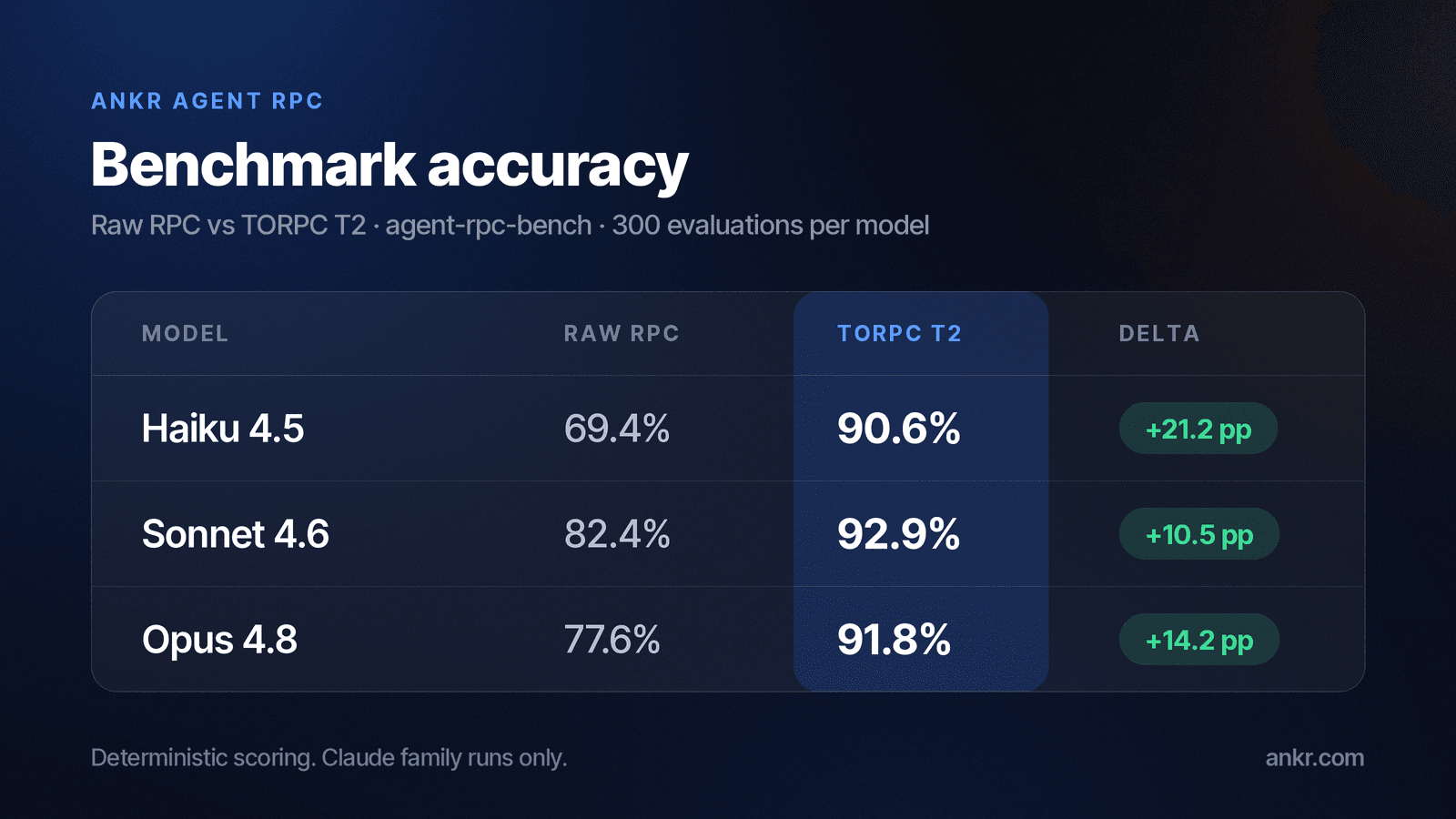
With raw responses, roughly one-quarter to one-third of answers were incorrect. Providing decoded, contextualized data raised accuracy above 90% across every model tested.
For your own evaluation, you can run the same questions against raw and decoded responses, compare every numeric answer with a deterministic reference value, and classify extraction, conversion, scaling, and reasoning errors separately. This will show whether your agent’s mistakes originate in its reasoning or in the format of the data it receives.
A production checklist for accurate blockchain agents
Before allowing an agent to report values or take onchain action, confirm that:
- Raw hex and fixed-point values are decoded before inference.
- Every number includes its unit, scale, type, and relevant chain context.
- Critical values are checked against a deterministic result.
- Evaluation uses exact-match scoring rather than output format alone.
- Tools operate on extracted, validated data rather than model-selected raw fields.
- The agent requests clarification or stops when required context is missing.
These controls apply beyond blockchain. Any agent consuming hex, base64, fixed-point values, timestamps, or ID-heavy API responses faces the same risk.
Build on a data layer designed for AI agents
We found frontier models subtly miscomputing values served from our own production endpoints in the standard industry format. The lesson is straightforward: language models should reason about blockchain data, while deterministic infrastructure handles its encoding.
Agent RPC gives developers that separation. It decodes blockchain responses before inference and delivers the structured context agents need to answer accurately, use tools safely, and take more reliable onchain actions.
Our benchmarks showed improvements of up to 21.2 percentage points, with every tested model exceeding 90% accuracy on decoded data.
Give your agent blockchain facts it can use confidently. Start building with Agent RPC.
Similar articles.

TORPC: The Open, Token-Optimized Solution Underneath Agent RPC
August 27, 2026
When we started building Agent RPC, the plan was to ship an MCP server that let an agent do both halves of the job: read...
Ankr and the Ripple Ecosystem: Institutional-Grade RPC Infrastructure for XRP Ledger
August 13, 2026
XRP Ledger sits at the centre of one of the most significant financial infrastructure networks in the world.
The Ripple ecosystem spans cross-border payment...