






The 2026 Blockchain x AI Report

June 2, 2026
12 min read
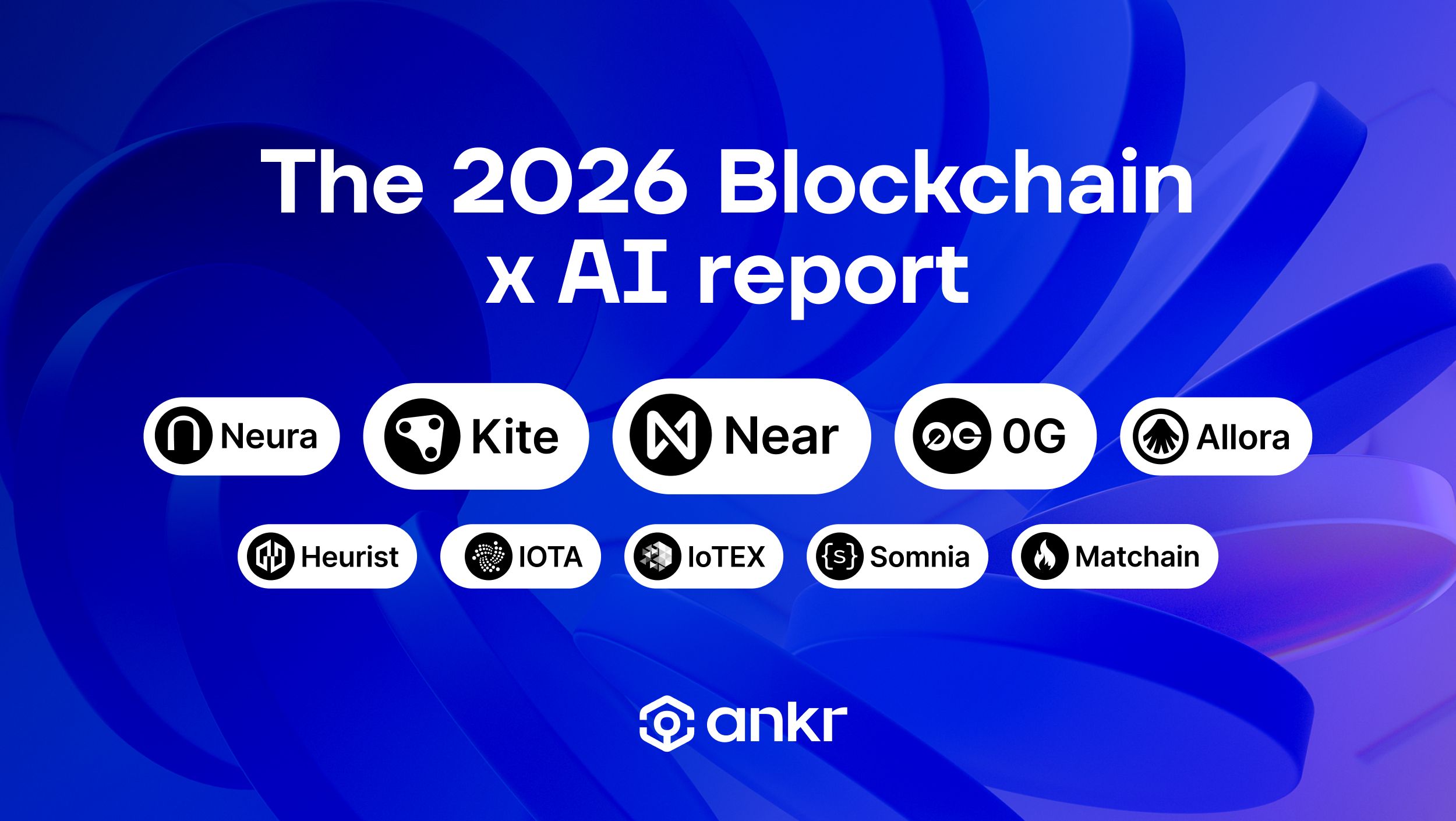
2026 has become an inflection point for AI x blockchain, as the hype has settled and capabilities have soared thanks to upgrades in both technologies. This includes x402, MPP, and other standards fast-tracking agentic payments, identity layers for agents, verifiable inference, decentralized compute, and more.
"The grand unification of AI and crypto is about to happen."
— a16z (@a16z) April 3, 2026
— Marc Andreessen
"It's now obvious that AI agents are going to need money—it's already happening."
"It's that William Gibson quote: the future is already here, it just isn't distributed yet."
"My friends who are the… pic.twitter.com/k9IMH2hYdG
As Ankr has been running blockchain RPC/API infrastructure across more than 100+ blockchain networks for years, we see what runs on them, notice traffic patterns, and see when the developer activity goes parabolic.
This article will provide an overview of some of the most interesting projects at the AI x blockchain intersection that Ankr has the best pulse on, as we support them via our node infrastructure.
These aren't rankings or endorsements, but rather a study of the networks where we've built the operational familiarity to say something true about what makes each one unique. What follows is an honest account of where these projects and the space at large stand in mid-2026.
Three Pillars Where Blockchain Best Supports AI
AI systems currently have three properties that create structural demand for something like blockchain infrastructure.
AI models are currently opaque: you cannot easily audit how a model arrived at an output, but blockchain can provide proof of every result. The cryptographic attestation that a model ran correctly needs to be recorded somewhere that can't be altered after the fact, that anyone can inspect, and that doesn't require trusting the same institution that ran the inference.
“We already see AI shaping significant portions of how we live and work. For example, the technology decides what millions of people see online, how goods move through supply chains and how loans are priced. But these systems largely remain secretive and closed off to the public. Very few people can easily check the logic behind how a model concluded or whether the data it used was trustworthy. As AI begins to run parts of the global economy, opacity stops being a technical issue and becomes a societal one.” – Sandeep Nailwal , CEO of Polygon Foundation, in Entrepreneur
AI requires enormous computational resources that are currently monopolized by a handful of hyperscalers. This leads to outside-the-box thinking for computational resources that the latest Nvidia partnership is getting ahead of by asking people to host mini data centers at their homes. In the blockchain space, projects like Render Network and Heurist are creating alternative GPU and computing resources for AI, orchestrated by onchain rules.
“Decentralized AI flips this paradigm by tapping into spare compute capacity such as idle GPUs in homes, offices or even smartphones. Platforms like Targon (Bittensor Subnet 4), focused on making AI inference faster and cheaper, aggregate distributed resources to deliver scalable solutions.” – Michael Kimelman via CoinDesk
Autonomous agents capable of executing real-world actions need financial rails, a way to spend, receive, and settle value, which traditional banking infrastructure was not designed to provide to software.
“The users of blockchain will be AI agents. AI is going to be on the front end, and blockchain is going to be the back end.” – Illia Polosukhin, co-founder of NEAR via CoinDesk
Blockchain infrastructure, for all its well-documented limitations, has properties that were built to address each of those problems in principle: transparency, decentralization, permissionless access to compute markets, and programmable money that any software can hold and spend without a bank account.
10 AI x Blockchain Networks Making It Work
Of all the blockchains Ankr runs nodes for, a meaningful subset have built identities around the AI x blockchain intersection. Here are the ten we consider substantive, along with what specifically makes each one interesting.
NEAR Protocol — The Unified Commerce Layer for AI Agents
NEAR's co-founder Illia Polosukhin co-authored the "Attention Is All You Need" paper, the 2017 transformer research that underpins essentially every modern large language model. For NEAR, this reflects an AI-native orientation that predates this hype cycle by years.
The most distinctive thing NEAR has built is NEAR Intents, a chain abstraction layer that lets agents operate across multiple blockchains without managing separate wallets, gas tokens, or bridges for every network they touch. Built on top of it, the AI Agent Market lets agents bid on tasks, execute work, and collect payment with no human in the loop, creating a circular economy where autonomous systems earn and spend independently.
The privacy layer another area where NEAR has gone further than most. IronClaw deploys agents inside hardware-encrypted enclaves so credentials stay private even from node operators. The Confidential GPU Marketplace extends that to compute, with TEE-secured processing and hardware-signed attestation in under 30 seconds. Polosukhin's framing cuts to it: "The goal is to make your AI hide all the blockchain. The fact that we have [blockchain] explorers is effectively a failure, because we don't abstract the technology."
KiteAI — Purpose-Built for the Agentic Economy
Kite's thesis is that AI agents are going to be core economic actors. This means they won’t just be tools, but participants in financial systems. And for that, we’ll need to do better than general-purpose blockchain tech. The specific problems Kite is solving surround the identity, payment, and governance layer for agents: how does an AI agent prove who it is, how does it pay and get paid, and how do you set programmable rules around what it's allowed to do?
The answers are the Kite Passport (a DID-based identity system for agents), a native integration of the x402 payment standard, and a novel consensus mechanism called Proof of Attributed Intelligence (PoAI) that rewards verified contributions from AI models and data providers. The $33 million Series A, co-led by PayPal Ventures and General Catalyst, is significant not just for the capital but for what PayPal's participation signals: an institution with 400 million users and its own stablecoin (PYUSD) is betting on agent-native blockchain infrastructure as a real commercial category.
0G (Zero Gravity) — The Full Stack for Decentralized AI
0G is the most technically ambitious project in this category, and also one of the most credibly executed. Built as a modular Layer-1, it includes four discrete components:
an EVM-compatible execution chain, a distributed storage network capable of 2 GB/s throughput, a data availability layer that runs 50,000x faster and 100x cheaper than Ethereum's DA layer, and a decentralized compute network with TEE-based sealed inference. 0G is attempting to build the complete infrastructure stack that AI agents need to operate without centralized cloud providers.
Its Aristotle Mainnet launched in September 2025, backed by $290 million from investors including Hack VC, Delphi Digital, Samsung Next, and Google Cloud. The 107-billion parameter model trained on its infrastructure in 2025 is the largest decentralized AI training achievement on record. With 100+ launch ecosystem partners, including Chainlink and Alibaba Cloud, 0G occupies one of the clearest "infrastructure for decentralized AI" positions in the market, and has the technical receipts to back it up.
Neura — Where AI Agents Clock In
Neura relaunched in May 2026 with the thesis of not just providing infrastructure for AI workloads, but creating a full economy where humans and AI agents participate together. Most chains building for AI agents treat them as back-end compute units. Neura is treating them as first-class economic actors, with verifiable identity, on-chain reputation, and the ability to be hired for real tasks alongside human users.
Neura’s most distinctive product is the Neuraverse, an immersive on-chain world where humans explore, trade, and complete quests while AI agents work alongside them with verifiable identity and payable task records. It's now live with 1.5M+ users and 100M+ testnet transactions already on record. The agent marketplace launching at mainnet will let users hire agents the way they'd hire any service, with a self-custodial, on-chain track record backing every agent's reputation.
The interoperability stance is also worth noting. Rather than shipping a proprietary SDK and asking developers to learn it, Neura is built on open agent standards, meaning any agent from any framework, Claude, ChatGPT, OpenClaw, or custom builds, can plug in directly. That's a deliberate bet against walled gardens in a space where most chains are still trying to lock developers into proprietary tooling.
Allora — Decentralized Intelligence as Infrastructure
Allora is doing something conceptually distinct from most projects in this space: it's not building a chain for AI applications to run on, but building a network of competing AI models whose aggregate output is more accurate and trustworthy than any individual model's output. The mechanism, called Inference Synthesis, takes a problem statement (for example, "predict the price of ETH in ten minutes"), routes it to a large pool of competing workers who submit predictions, and uses a reputation-weighted consensus process to produce a single synthesized result that is statistically superior to any individual model.
The cryptographic underpinning is zkML: workers submit zero-knowledge proofs alongside their predictions, which verify that their model actually ran correctly without revealing proprietary model details. This is an elegant solution to the verifiable inference challenge described earlier in this article. Built on Cosmos and launched on mainnet in November 2025, Allora is backed by Polychain, Framework Ventures, and Blockchain Capital, and is already integrated across DeFi protocols that need trustworthy price oracles and market signals.
Heurist — Decentralized AI Cloud and Agent Marketplace
Heurist's thesis is straightforward: the agentic economy needs a marketplace where specialized AI capabilities can be discovered, composed, and paid for at machine speed. Its answer is Heurist Mesh, an open network of modular, purpose-built AI agents that collectively form an intelligent swarm to tackle complex tasks. Mesh includes 30+ specialized agents for Web3 workloads, accessible via REST API or MCP, with each agent invocation generating pay-per-use revenue for its author. The payment layer runs on x402, meaning agents can pay other agents for compute and skills in real time without human intervention.
The underlying infrastructure is the Heurist Chain, a sovereign Layer 2 built on ZK Stack and Avail's data availability layer, developed in partnership with Asphere, Ankr's enterprise services arm. It handles verifiable resource allocation, compute execution, and on-chain settlement between agents.
IOTA — Machine Economy, Patient Architecture
IOTA has been building toward the machine-to-machine economy since 2017. The original thesis (a Directed Acyclic Graph-based ledger with zero fees, designed for IoT devices to transact with each other) was architecturally prescient in ways that weren't obvious until AI agents became a real category.
The IOTA 2.0 network and its EVM-compatible sidechain have moved the project toward practical deployment rather than vision documents. The late-2025 ADAPT initiative in Africa, backed by the AfCFTA Secretariat, the World Economic Forum, and the Tony Blair Institute, demonstrates real-world infrastructure deployment in trade finance and digital identity. IOTA's patient construction of machine-native infrastructure, zero-fee transactions for device-to-device micropayments, and accumulated institutional relationships make it a strong player in the AI agent economy.
IoTeX — Physical AI and the Real-World Data Layer
IoTeX occupies a specific and defensible position, “Where AI touches life.” It's the chain for real-world AI, meaning AI systems that need data from the physical world. Its Quicksilver framework provides a verifiable pipeline from IoT sensors and physical infrastructure (cameras, energy meters, connected vehicles) to AI training and inference pipelines. The Real-World AI Foundry launched at Token2049 Singapore in October 2025 with Vodafone, Filecoin, Theta, and twenty-plus partners, positioning IoTeX as the infrastructure layer for AI models trained on verified physical-world data rather than internet scrapes.
The architectural distinction matters: most AI chains are building for digital-native agents operating in digital environments. IoTeX is building for physical-world intelligence. They provide for AI systems that need to interact with energy grids, supply chains, mobility infrastructure, and industrial hardware. That's a different market with different requirements, and IoTeX has eight years of DePIN infrastructure under it.
Somnia — The Agentic L1 for Interactive Worlds
The team behind Somnia built some of the most technically sophisticated multiplayer simulation infrastructure in gaming at Improbable. That background shows in the architecture. Somnia processes over one million theoretical TPS with sub-second finality, and its custom IceDB database achieves 15-100 nanosecond read/write times — numbers that only matter if you're building for environments where millions of things are happening simultaneously and latency is the difference between an experience that feels alive and one that doesn't.
That's exactly the environment AI agents operate in. The subscription-based RPC system introduced in late 2025 lets applications subscribe to specific on-chain data streams rather than constantly polling for updates, which is how reactive infrastructure should work when agents need to respond to on-chain events in real time rather than check whether something happened. Most chains weren't designed for that interaction model. Somnia was, because games weren't either, and Improbable spent years solving that problem before blockchain entered the picture.
The result is a chain where the properties that make it good for millions of concurrent players also make it good for millions of concurrent agents. That overlap isn't a marketing angle. It's load-bearing architecture that came from building something genuinely hard before AI x blockchain was a narrative worth chasing.
Matchain — AI Identity and the Data Sovereignty Problem
Matchain is tackling the identity layer of the AI economy from a user data perspective rather than an agent identity perspective. Its core product, MatchID, is a W3C-compliant decentralized identity system that unifies a user's Web2 and Web3 identities (social logins, wallet addresses, and behavioral data) into a single self-sovereign identity that the user controls.
Their logic is clear: AI systems need user data to personalize and improve. Users currently have no control over that data and receive no economic benefit from its use. Matchain's architecture allows users to consent to sharing specific data attributes with specific AI applications, receive compensation for that sharing, and revoke access without losing their identity continuity. The Paris Saint-Germain partnership, which routes fan engagement data through the MatchID system, provides a mass-market proof-of-concept with a user base that isn't primarily crypto-native.
Where AI x Blockchain Is Heading
The "AI agent as primary blockchain user" thesis is almost certainly correct. Autonomous systems capable of executing complex workflows, combined with programmable money that any software can hold, inevitably produces software operating as economic actors at a scale human users never could. The infrastructure being built for that reality is early but genuine.
Verifiable inference is the unsolved problem everything else depends on. Until AI outputs feeding on-chain applications can be cryptographically verified, there's an enormous trust assumption baked into any system combining AI decision-making with blockchain execution. zkML is promising but expensive. TEEs are practical but require trusting hardware vendors. This gets solved, but the timeline is years not months.
Data provenance is underrated. As AI-generated content gets mixed into training datasets for future models, the question of where data came from and under what conditions becomes a structural problem. Blockchain's immutable record is useful here in ways that have nothing to do with speculation.
The chains that survive will have genuine architectural differentiation. General-purpose EVMs with AI marketing aren't in this race. The projects that matter made specific technical choices reflecting a real understanding of what AI workloads require. That list is shorter than market cap rankings suggest.
The RPC layer is invisible infrastructure for all of it. Every AI agent that holds a wallet, executes a contract, or settles a payment does so through RPC infrastructure. That's the vantage point we occupy at Ankr, across every project in this article, and it's why we wrote it.
Start building AI x blockchain apps with Ankr
Join the Conversation on Ankr’s Channels!
X | Telegram | Substack | Discord | YouTube | LinkedIn | Reddit
Similar articles.
Let’s Get Agentic: The State of Crypto AI Agents in 2025
February 18, 2025
Imagine using software that doesn’t just follow your commands but thinks, learns, and adapts—advancing your goals autonomously. This is exactly what AI agents are designed...
Ankr To Launch RPCs for Kite, the First AI Payment Blockchain
May 1, 2026
Ankr is excited to announce the upcoming launch of Kite Chain RPCs on our Web3 API service! Kite is a purpose-built Layer 1 blockchain designed...